
What happens in Afterschool...
Changes what happens in School
Why Afterschool Matters
Out-of-school-time learning can be life-changing for students. Even seemingly simple things, like knowing the vocabulary in a STEM elective, makes a huge difference in confidence and persistence.
Eika, CEO of STEAM Street in Texas, describes what she sees in her students. “I think that it’s important to have a safe space, maybe even a counter space, if you will, for girls to be able to be authentically themselves, unapologetically. In this type of environment, informal education, it’s okay to have those “aha!” moments.
And for a lot of the girls, once they have that “aha!” moment, they can own that. And then once they get into their regular classroom, they can be like, “Hey, I know exactly what we’re doing. I did that in Techbridge Girls.” They feel more confident because of that “aha!” moment that they had in a less traditional environment.”
Those “aha” moments build confidence. That confidence leads to choices, like participating in STEM electives, clubs, and events. And those choices lead to lasting impact, like educational pathways, career opportunities, and economic mobility.
We’ve been making room for “aha” moments since 2000.This is serious work – and it’s seriously fun.
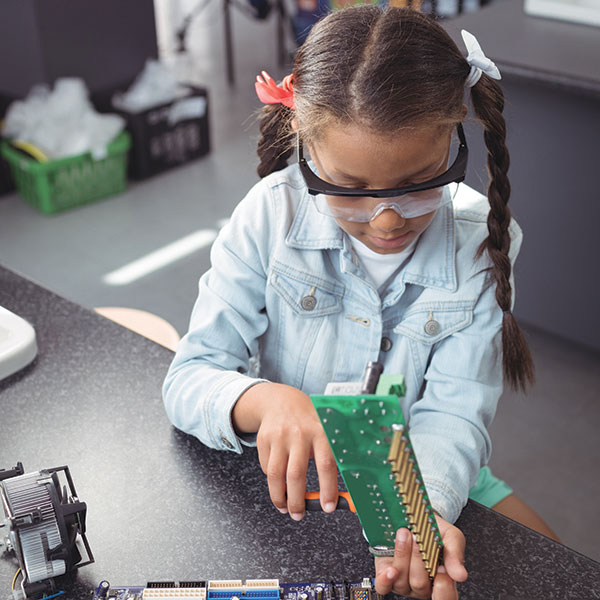
“Hey, I know exactly what we’re doing. I did that in Techbridge Girls.” They feel more confident because of that “aha!” moment that they had in a less traditional environment.”
The Techbridge Difference
Afterschool programs improve outcomes IN school too, according to a groundbreaking new 26 year longitudinal study released in 2025.
The research is clear: Afterschool programs are a wise investment that supports the well-being, academic achievement, and future success of all young people, especially those from disadvantaged backgrounds.
KIDS WHO PARTICIPATE IN AFTERSCHOOL PROGRAMS BENEFIT INTO ADULTHOOD. THEY ARE STRONGER:
Learners
Earners
Leaders
Research based on the groundbreaking 26-year longitudinal study, Study of Early Child Care and Youth Development (SECCYD).
Findings from elementary school (K-5), where Techbridge Girls begins, were consistent – more periods of organized activities predicted higher math and reading scores, even after controlling for other experiences and academic achievement measured before kindergarten.
Gains in middle school (where TBG is a bridge for 8th graders going to high school), continue the trend above, including better academic performance and test scores, engaging in more challenging coursework and increased civic engagement.
TBG’s National Science Foundation research with Oakland Unified confirmed that those who participated in TBG were more likely to take AP courses in high school especially in math, and graduate at twice the rate of their non-TBG peers.
Consistent participation in afterschool programs predicted better grades, relationships with peers and adults, improved social skills and decreased behavioral problems.