image

Family Resources

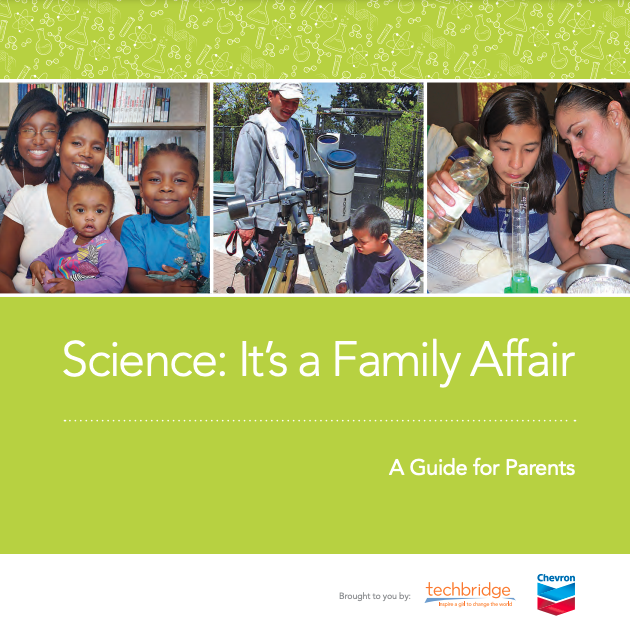
Family Science Guide

guideParents play an important role in their child’s love of learning. From day trips to talks around the dinner table, there are lots of easy and fun ways to spark a love of science. Your next conversation or outing could inspire the future engineer inside your child.

Download Science: It’s a Family Affair, the family guide we developed for the Bay Area that provides advice for encouraging your children in science, and ideas for science museum visits, hands-on activities, and other things you can do as a family.

English | Spanish | Chinese

To request printed copies of our Family Guide (while supplies last), please contact us.

Visiting Your Nearby Science Centers

An afternoon at a science museum makes discovery fun and can set your child on a lifelong love of science. It’s also a great way to spend quality time with your family without the distractions of computers and TV. Not sure where to go? We’ve put together a list of Bay Area science museums and centers.

Here are some tips to make your family’s visit fun and meaningful from start to finish.

  • Create a custom tour. Check out the museum’s website and plan your visit around the exhibits, special events and shows that interest your family.
  • Investigate together. Spend time reading the information at your favorite exhibits. Ask open-ended questions to help your child understand the content and connect what they already know. Why do you think this is happening? What would happen if…? How does this relate to…?
  • Model curiosity. Seek answers by using the resources around you. Asking questions is a powerful way to model how new discoveries are made. Enlist help from  relatives, teachers, or museum staff if you can’t find the answer.
  • Connect to school. Know what your child is learning in his or her class. Let your child be the expert and explain to you the most fascinating concept he or she learned in class and how it relates to the exhibit.
  • Follow up on interests. After a fun day at a museum explore some of the topics that your child enjoyed. Find books with related experiments, at-home activities, or news articles that expand on what you saw. Check out Science News for Kids or Exploratopia by The Exploratorium for more ideas
  • Continue the learning at home. Look for shows that are related to your experiences at the museum. Check out PBS, The Discovery Channel, and Animal Planet for family-friendly science.
Exploring Careers in Science, Technology and Engineering

Unleash the wonders of science, technology and engineering by introducing your child to the amazing careers of today and tomorrow. Does your child hope to make the world a better place? Scientists and engineers dream up creative solutions for everyday problems. They ask questions to better understand the world, and search for answers to improve the quality of life all around the world.

Here are some ideas to help your child explore the possibilities for the future.

  • Make summer a time to explore new interests and careers. Find science, technology, and engineering programs and events in your community. Start your search at your local library, newspaper and city website. Organizations like Girl Scouts, YMCAs, YWCAs, and museums offer summer science and engineering programs. Check out our Summer Opportunities Guide for more options.
  • Visit college campuses. Include college tours during your next family vacation. Colleges have community outreach days and offer tours and workshops for families. Visit the college website for more information.
  • Role models matter! Find someone whom your child can talk with to learn more about colleges and careers. Reach out to your network of friends and family to find STEM professionals. Connect with a teacher or school counselor if you need more help. Seek role models in your area at www.fabfems.org.
  • Explore local opportunities. Visit beaches, wetlands, and national and state parks. Take advantage of the natural resources your community has to offer.
  • Help your child discover his or her dream job at Engineer Your Life, Engineer Girl and Design Squad.
Girls Can!

Weren't we all inspired by gazing at the night skies as children? And yet only one fourth of professional astronomers are women. Today’s challenges are calling for creative solutions, but only 12% of today’s engineers are U.S. women.

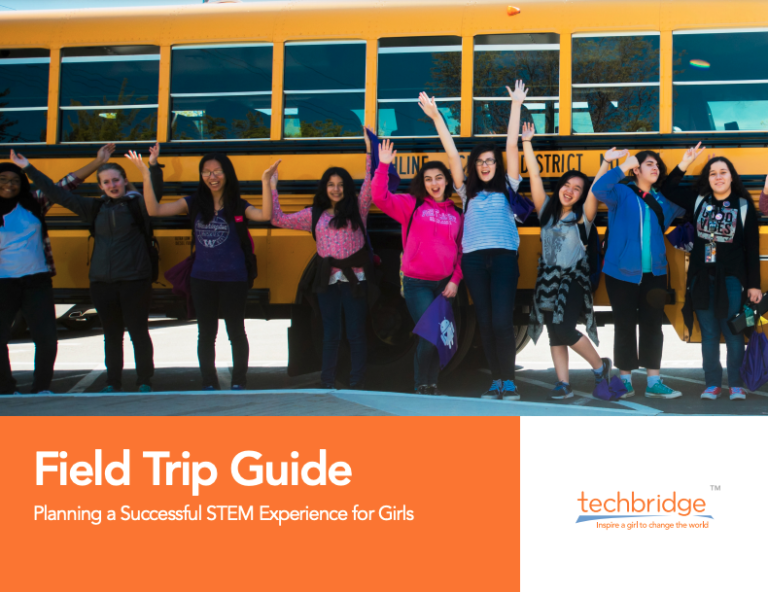
It’s not that girls can’t do science or don’t like math, but they may lack the confidence and interest. Here are ideas to help spark a girl’s interest in science and engineering:

  • Techbridge’s Favorite Gift Ideas and Fun Activities to Encourage Girls in STEM
  • Look for girl-friendly games and toys. Goldie Blox, Roominate, and K’NEX are great toys for girls. Find even more ideas at Techbridge's List of Presents for Encouraging Girls in Technology, Science, and Engineering. [link to the doc for this page]
  • Find girl-only summer science programs. Check out Techbridge's List of Summer Opportunities for Girls in Technology, Science and Engineering. [link to doc]
  • Read about inspirational women. The Women's Adventures in Science and Sally Ride Science offer career books.
  • Expose girls to media that highlight females in STEM. SciGirls on PBS features real girls ages 11-14 as scientists and engineers.
  • Show that you are interested. Ask your daughter about her science lessons. Research has demonstrated that parents’ beliefs and attitudes influence children’s development and interests.
  • Don’t let negative stereotypes influence your daughter. Girls excel in science and math just as much as boys. For fun math activities check out Girls Get Curves, Math Doesn't Suck, and Kiss My Math.
  • Discuss how technology products help people. Girls often express interest in how technology will be used—its application—and how it can make the world a better place.
  • Search out other resources.  Sally Ride Science offers a handbook with ideas for parents to support their daughters. Girls and Adults Learning Science Together offers activities for girls ages 5-14.
  • Make time to tinker. Give girls the opportunity to play with games and toys that develop spatial skills. Research shows that young women arrive at college with less hands-on experience than males.
  • Make science a collaborative affair instead of a competition. Girls thrive in teams and enjoy working together. Create a learning environment that suits girls’ needs and interests.
Hands-on Activities for Families

You don't need to be a rocket scientist to encourage your son or daughter to be one. You can support a budding engineer by encouraging tinkering and creativity. Did you know that many scientists and engineers know by eighth grade what they want to be? They recall activities they did at home or school that sparked an interest. Here are activities that you can do together.

  • Fun with Polymers
    Can you create the bounciest ball? Try being a chemist and come up with the perfect combination of borax, glue, corn starch, and water to make the best ball ever.
  • Mini Kites
    Create your own mini kite using tissue paper, string, and tape. Use this as a basis for understanding what makes a kite work and then design your own large kite.
  • Marble Roller Coaster
    What does it take to be a roller coaster engineer? Design a roller coaster for a marble, using random materials around your house.
  • Reverse Engineering
    Take apart your favorite non-working household device and discover how all the pieces work together.
  • Markerbot
    Make artwork using your very own Markerbot with a 3 volt motor, paper cup, and marker.
  • Egg Drop
    Create a device that will safely hold an egg as it is dropped from a height.
  • Gumdrop Dome
    What’s more stable, triangles or squares? Test your ability as a structural engineer by designing and building the strongest dome possible.
  • Straw Bridges
    Design and build a bridge out of straws, paperclips, and tape. Then build your next bridge with hot glue and popsicle sticks.
  • Paper Structures
    What makes a structure stable and strong? Design and build the strongest structure using a limited amount of paper.

Here are some ideas to keep in mind when designing with your child:

  • Let them take the lead in handling materials, giving directions, and exploring.
  • Work as a team - don't be afraid to have fun, too.
  • Give them time to think and explore. Silence often means that your child is thinking about what is going on.